Once AI systems affect customers, employees, pricing, decisions, or regulated workflows, auditability stops being optional.
At some point someone will ask:
- what model version handled this request?
- what data was used?
- who changed the prompt or policy?
- why did the system return this result?
- what happened during the incident window?
If the system cannot answer those questions clearly, the problem is not just observability. It is governance and operational readiness.
Audit Logs Are Not the Same as Debug Logs
Debug logs help engineers troubleshoot.
Audit logs serve a different purpose:
- accountability
- reconstruction of events
- investigation support
- evidence of controls
- traceability for sensitive actions
That means audit logging should be more deliberate than simply dumping application output into a log stream.
What an AI Audit Trail Should Capture
A useful AI audit trail usually includes:
- actor identity or tenant
- request timestamp
- route or use case
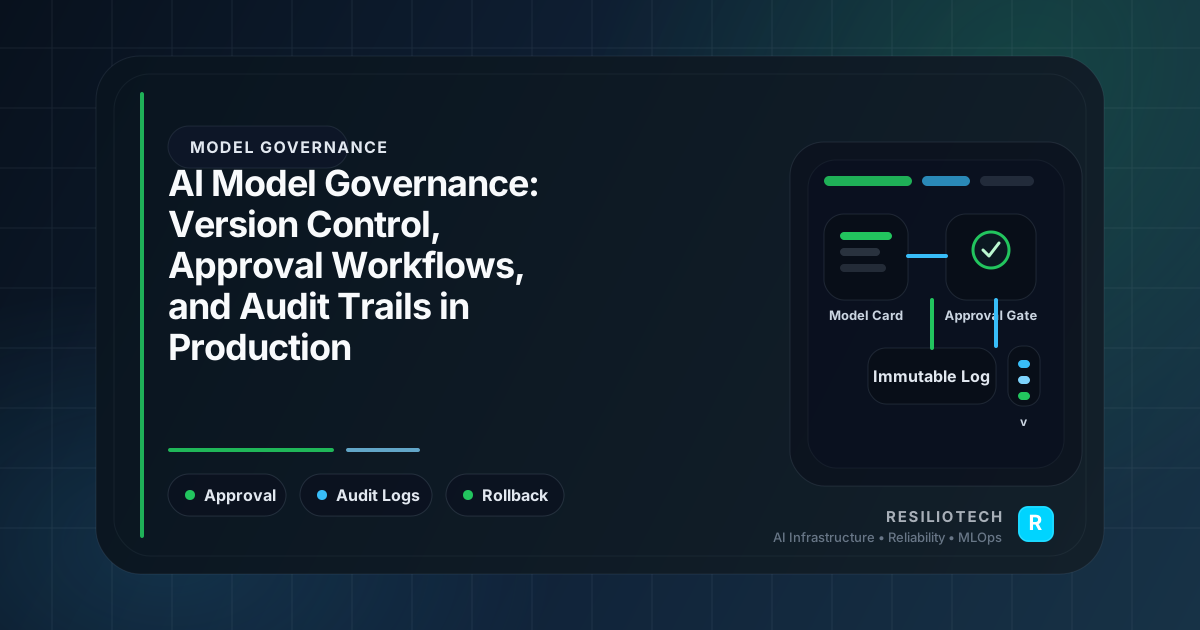
- model and prompt version
- policy or tool configuration version
- retrieval source references where relevant
- operator actions and administrative changes
- decision or response metadata
The point is not storing every token forever. The point is preserving enough context to explain what happened.
Versioning Context Matters
For AI systems, a request is shaped by more than the model name.
You often need to know:
- model version
- prompt template version
- evaluator or guardrail version
- retrieval index or knowledge snapshot
- policy configuration active at the time
Without version context, post-incident review becomes hand-waving.
Administrative Actions Need Strong Logging
Many important failures come from control-plane changes rather than from user traffic.
Examples:
- prompt update deployed without review
- guardrail configuration changed
- a routing rule switched traffic to a different model
- a policy exemption was granted
- logging or retention settings were modified
These changes should be logged as first-class audit events with actor, time, and before/after context where possible.
Balance Traceability with Privacy
Audit logging does not mean storing raw sensitive prompts indiscriminately.
Good audit design balances:
- enough data for accountability
- redaction of unnecessary sensitive content
- retention controls
- access restrictions for audit records
That is especially important for systems touching personal data, regulated content, or internal business secrets.
Make Logs Searchable by Investigation Questions
A useful audit system should answer questions like:
- which model and prompt version served this response?
- which operator changed the policy?
- which tenant saw degraded outputs during the incident?
- which retrieval source was used?
- which requests were blocked or overridden?
If logs exist but cannot answer practical investigation questions quickly, the system is still underprepared.
Retention and Integrity Matter
Audit records are less useful if they are:
- easy to alter
- inconsistently retained
- spread across too many systems
- missing timestamps or actor identity
For higher-stakes workflows, teams should think about:
- retention windows
- access controls
- immutable or append-only storage patterns
- consistent event schemas
This turns audit logs into a trustworthy operational record instead of just another log bucket.
A Practical AI Audit Event Model
For many organizations, a good event model includes categories like:
- user request events
- model or prompt version events
- policy and guardrail change events
- admin override events
- retrieval and tool invocation metadata
- incident and rollback events
This gives you enough structure to investigate behavior without trying to log every internal implementation detail.
Common Mistakes
These are common:
- debug logs used as a substitute for audit logs
- no prompt or policy version in the trail
- control-plane changes not logged
- audit logs containing too much raw sensitive content
- retention and access rules left undefined
Audit readiness is usually about consistency and structure more than about volume.
Final Takeaway
Regulators, customers, and internal risk teams will not just ask whether an AI system was available. They will ask who changed it, what it used, and how a specific output can be traced back to the configuration active at the time.
AI audit logs should be designed to answer those questions calmly and quickly. If they are not, the right time to fix that is before the first serious review or incident.
Need help building audit trails for production AI systems without over-logging sensitive data? We help teams design logging, version traceability, and control-plane event models that support both operations and governance. Book a free infrastructure audit and we’ll review your current setup.