Most AI infrastructure RFPs fail in the same way: they ask for impressive feature lists and miss the things that actually determine whether a vendor will work in production.
They ask:
- do you support Kubernetes?
- do you have model monitoring?
- can you run on our cloud?
Those are not useless questions. They are just too shallow.
An effective ai infrastructure rfp template should help you answer the questions that matter once the sales process ends:
- can this vendor support our actual workload shape?
- what operating model are we really buying?
- how much custom work will still fall on our internal team?
- what are the cost and lock-in implications at scale?
This is especially important in ai platform procurement, where teams are evaluating:
- MLOps platforms
- managed model serving vendors
- model gateways
- AI observability stacks
- consulting or implementation partners
The goal of the RFP is not to collect polished answers. The goal is to make weak vendors reveal themselves early and strong vendors answer in a way your engineering team can actually verify.
At the end of this post, there is a downloadable template you can use directly:
Download the AI Infrastructure RFP Template
Start With Your Actual Use Case
Do not send an RFP that describes an imaginary future-state platform without describing your current operating reality.
Every vendor answer is shaped by the problem statement you give them.
Your RFP should state:
- current deployment model
- model count and expected growth
- primary workloads
- latency and availability expectations
- compliance requirements
- internal team maturity
For example, these are very different procurement contexts:
- 4 production models, one ML team, mostly batch and light inference
- 20+ models, multiple teams, shared GPU serving, strict cost controls
- enterprise LLM gateway, model routing, audit logging, and vendor neutrality requirements
If you do not explain which world you are in, vendors will answer to the broadest and easiest possible version of the problem.
That makes mlops vendor evaluation much weaker than it should be.
Ask for Architecture, Not Marketing
One of the strongest sections in an RFP is the architecture response.
Require vendors to explain:
- control plane design
- deployment model
- data plane dependencies
- security boundaries
- observability approach
- scaling assumptions
Ask them to describe the system as it would run in your environment, not in their best-case demo environment.
Useful questions include:
- What components run in our account or cluster versus yours?
- What infrastructure do we still operate ourselves?
- What are the hard dependencies for inference, training, artifact storage, and monitoring?
- What breaks if one control-plane dependency is unavailable?
This is where weak vendors often reveal that their “platform” is mostly orchestration around assumptions that may not fit your stack.
Force Specific Answers on Security and Compliance
Security sections in many RFPs are too generic.
Do not accept broad claims like:
- enterprise-grade security
- SOC 2 compliant
- secure by design
Ask for specifics:
- identity and access model
- customer isolation approach
- secrets handling
- audit logging scope
- encryption at rest and in transit
- regional data residency support
If relevant, ask directly:
- How are model artifacts protected?
- How are prompts, outputs, and feature data logged or redacted?
- What controls exist for tenant or team-level access boundaries?
- What evidence can be produced during a compliance review?
This matters because in ai platform procurement, vague security answers often hide major implementation work that your own team will end up owning later.
Cost Structure Needs Its Own Section
Vendors will happily talk about features and often gloss over cost behavior.
Your RFP should explicitly require:
- pricing model
- scale assumptions
- likely cost drivers
- support or professional services dependencies
- migration or exit considerations
Make them answer questions like:
- What happens to cost when model count doubles?
- What happens when request volume becomes steady rather than bursty?
- Which features or deployment modes create the largest price jumps?
- Which parts of the platform are metered separately?
If the vendor supports AI inference directly, ask for cost examples at:
- low scale
- medium scale
- high scale
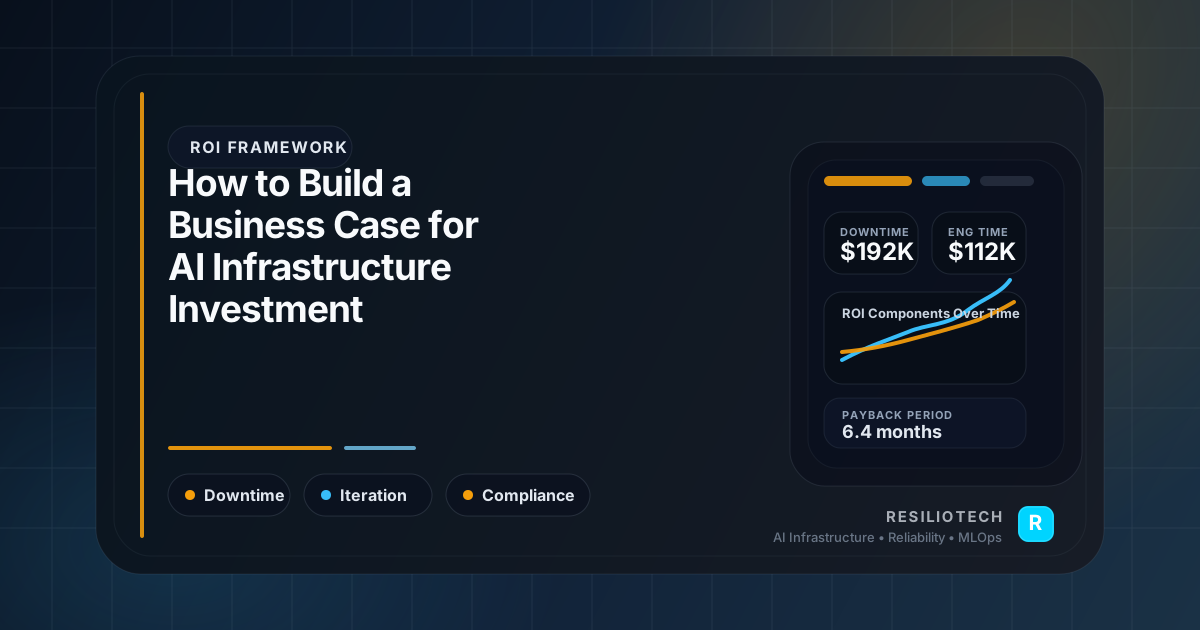
This is especially useful when comparing managed versus self-hosted or platform versus consulting options. Cost transparency is a core part of mlops vendor evaluation, not a finance-only afterthought.
Ask About Operating Model, Not Just Product Surface
Many teams evaluate only the product and forget the day-two work.
But AI infrastructure decisions are usually more about operating model than feature checklists.
Ask:
- Who owns upgrades?
- Who debugs failed deployments?
- What telemetry is included by default?
- How are incidents handled?
- What kind of rollout and rollback controls exist?
- What level of internal platform maturity does the vendor assume?
This is one of the best ways to compare vendors honestly.
Two products may both claim to support:
- model serving
- monitoring
- versioning
But one may assume a mature platform team while the other is genuinely optimized for a small team trying to move quickly.
That distinction matters more than feature parity.
Require Real Reference Scenarios
Do not ask only for customer logos.
Ask vendors to describe:
- one deployment similar to your scale
- one incident or failure mode they helped resolve
- one migration or rollout where they handled complexity similar to yours
A good RFP question is:
- Describe a production environment you support that is closest to our use case. Include model count, deployment shape, traffic profile, and operational challenges.
That is much harder to bluff than:
- list enterprise customers
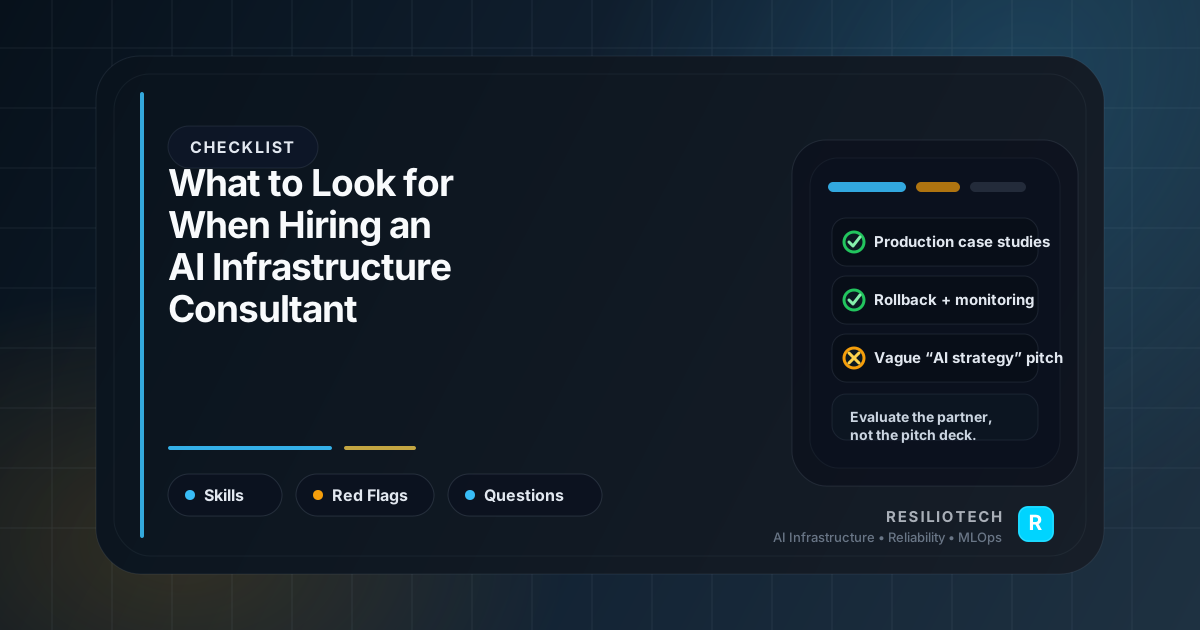
The same logic applies to consulting or implementation partners. Ask for concrete production examples, not only “experience in AI.”
Include Evaluation Weighting Up Front
An RFP without a scoring model usually turns into politics later.
You do not need a perfect procurement science framework, but you do need declared weighting.
A practical scoring split might be:
- 25% architecture fit
- 20% security and compliance
- 20% operating model and support
- 20% cost structure
- 15% implementation speed and references
The exact weights depend on your situation, but declaring them helps vendors answer in the right level of depth and helps your team compare responses more honestly.
This is also where gated content is useful: a real template should not only list questions, it should guide the scoring structure too.
What to Avoid in Your RFP
There are a few common mistakes:
1. Asking only generic feature questions
This leads to generic yes-or-no answers and hides operational gaps.
2. Hiding your real constraints
If you do not mention latency, compliance, or internal skill limitations, the answers will not reflect reality.
3. Mixing strategy and implementation without saying which you need
Some vendors are strong product providers. Some are strong implementation partners. Some are both. Your RFP should make clear which role you are evaluating.
4. Ignoring migration and exit
Ask what it takes to migrate in, and what it takes to leave. That is part of serious ai platform procurement.
What the Downloadable Template Includes
The downloadable template is structured for practical enterprise use. It includes sections for:
- company background and current stack
- use case and workload profile
- architecture and deployment requirements
- security and compliance questions
- observability and operations requirements
- pricing and commercial structure
- implementation and support expectations
- reference and proof questions
- evaluation scoring table
You can use it as:
- a first-pass procurement document
- an internal alignment draft before sending to vendors
- a consulting evaluation template for implementation partners
Download it here:
Download the AI Infrastructure RFP Template
Final Takeaway
An ai infrastructure rfp template is only useful if it forces vendors to answer the hard questions before you commit.
For strong mlops vendor evaluation, your RFP should cover:
- real workload shape
- architecture fit
- security and compliance controls
- operating model expectations
- cost behavior at scale
- references grounded in environments like yours
That is how ai platform procurement becomes an engineering decision with commercial discipline, instead of a feature comparison that creates more ambiguity than clarity.