Most AI features fail in one of two bad ways.
Either:
- they return an error and disappear completely
or
- they stay technically available while becoming slow, unreliable, or obviously wrong
Neither is acceptable in production.
If your GPU node crashes, your inference queue backs up, or your LLM provider is unavailable, the right question is not only:
- how do we restore full service?
It is also:
- what useful version of the feature can we still provide right now?
That is what ai graceful degradation means in practice.
A good degradation strategy does not pretend the primary model never fails. It plans the fallback path in advance so the product remains usable, honest, and operationally controllable during the incident.
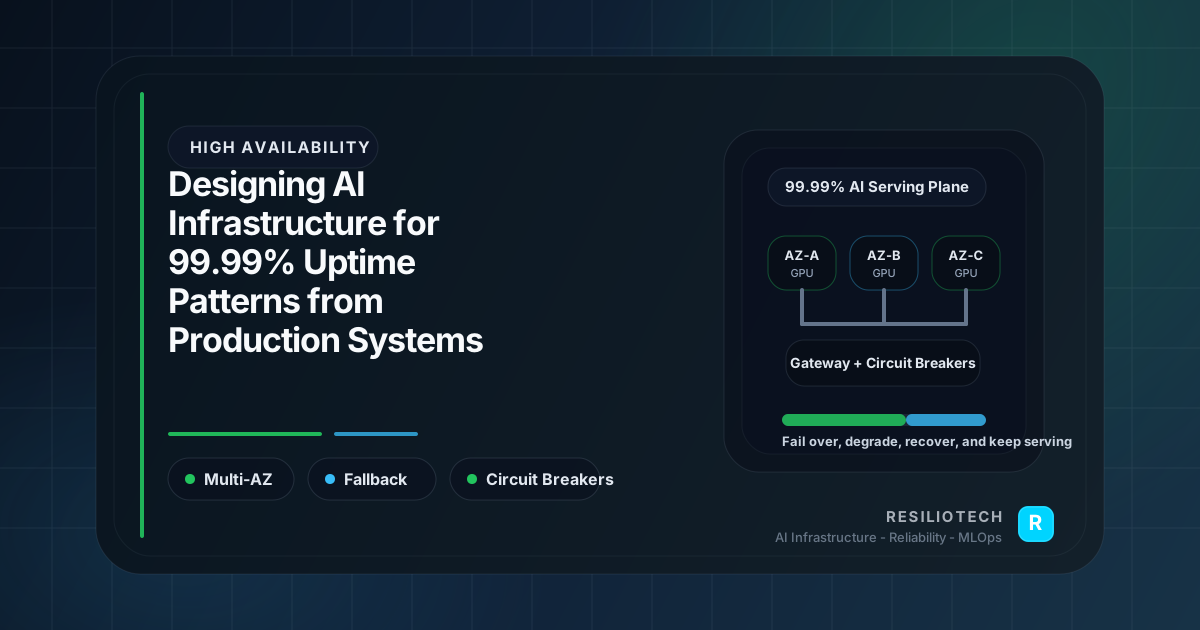
This post covers the practical ml fallback strategy patterns that actually work:
- cached responses
- smaller backup models
- rule-based or deterministic systems
- feature flags and scope reduction
Start With the User Experience, Not the Infrastructure Diagram
Graceful degradation is not only an infrastructure topic. It is a product-behavior topic.
Before choosing technical fallbacks, define what the user should experience when the primary AI path is unavailable.
For each AI feature, ask:
- what is the minimum useful outcome?
- what is unacceptable behavior?
- can the experience become narrower without becoming broken?
For example:
- an AI support assistant might fall back to retrieval-only answers
- a recommendations module might fall back to cached top items
- a fraud model might fall back to simpler rules and manual review
- a summarization feature might disappear behind a feature flag instead of timing out every request
That framing is important because the best fallback is not always “another model.” Sometimes the best fallback is a simpler experience that still serves the user honestly.
Build a Fallback Ladder, Not a Single Backup
Teams often design fallback as one binary switch:
- primary model
- backup model
That is too fragile.
A stronger pattern is a fallback ladder:
- primary AI path
- smaller or cheaper model
- cached or precomputed result
- deterministic rules or retrieval-only path
- feature reduction or temporary disablement
This gives operators more room to react.
It also helps product teams decide what level of degradation is acceptable for each feature class.
For many ai feature degradation production scenarios, the right answer is not one backup. It is multiple controlled downgrade states.
Fallback 1: Cached Responses
Caching is one of the best fallback tools when:
- prompts or requests repeat often
- recent outputs remain useful for some time window
- full real-time freshness is not required
Examples:
- help-center answers
- internal documentation Q&A
- product copy suggestions
- standard customer-support flows
A practical pattern:
def get_ai_response(request):
cache_key = build_cache_key(request)
try:
return primary_llm(request)
except Exception:
cached = response_cache.get(cache_key)
if cached:
return {
"mode": "cached",
"content": cached["content"]
}
raise
The important operational detail is not only to cache responses. It is to label them clearly in telemetry so the team can see:
- fallback activation rate
- cache hit rate during incident mode
- whether the degraded path is actually carrying the load
Cached fallback works well when the content shelf life is longer than the outage.
It is a poor fit for:
- fast-changing transactional decisions
- highly personalized outputs
- sensitive outputs that must reflect current state
Fallback 2: Smaller Models
This is often the most obvious fallback, and sometimes the most useful.
If your primary path depends on:
- a large local model on GPU
or
- a premium hosted model with tighter rate limits
then a smaller model can preserve partial capability with lower cost and lower infrastructure pressure.
For example:
def generate_answer(request):
try:
return primary_model.generate(request)
except Exception:
return fallback_model.generate(request)
But do not stop at the code path. Define when the smaller model is allowed to activate.
Good triggers include:
- GPU fleet unavailable
- queue depth above threshold
- provider API unavailable
- p95 latency above user tolerance
This is important because smaller-model fallback should not depend on a human manually editing config during an incident if the feature is customer-facing and high-volume.
Also be honest about quality boundaries. A smaller model may be appropriate for:
- classification
- short summaries
- lightweight extraction
and inappropriate for:
- complex reasoning
- high-risk decision support
- high-stakes user-facing answers
Fallback 3: Rule-Based or Retrieval-Only Systems
Some teams hear “rule-based fallback” and assume that means old, inferior architecture.
That is the wrong mindset.
Deterministic fallback is often the most trustworthy degraded mode because it is predictable.
Examples:
- fraud screening falls back to threshold and allowlist rules
- AI routing falls back to keyword-based intent routing
- support chatbot falls back to retrieval with direct document snippets
- recommendation system falls back to popularity plus inventory rules
This is especially important when the primary AI path is not just unavailable, but potentially untrustworthy during a degraded state.
A retrieval-only fallback example:
def support_answer(query):
try:
return llm_rag_pipeline(query)
except Exception:
docs = retrieve_top_documents(query, k=3)
return {
"mode": "retrieval_only",
"documents": docs
}
The product may be less polished, but it is still useful.
That is the standard to aim for: degraded does not mean impressive. It means dependable enough to bridge the outage.
Fallback 4: Feature Flags and Scope Reduction
Sometimes the best fallback is not another inference path. It is reducing the feature surface.
Examples:
- disable AI-generated explanations but keep search
- disable personalized ranking but keep default ranking
- disable free-form generation but keep pre-approved templates
- turn off long-form summarization while preserving extraction
This is why feature flags matter so much in AI systems.
A product team should be able to say:
- keep the feature on for enterprise tenants only
- disable the most expensive mode
- switch from “generate and personalize” to “retrieve and display”
That kind of scoped reduction is often better than letting the whole feature fail noisily.
If your only incident control is “all on” or “all off,” the system is harder to operate than it needs to be.
Match the Fallback to the Failure Mode
Not every incident should trigger the same degraded path.
If the GPU node crashes
Possible responses:
- route to another cluster
- switch to a smaller CPU-friendly model
- serve cached outputs
- disable expensive modes
If the LLM API is down
Possible responses:
- fail over to a second provider
- fall back to a local open-weight model
- switch to retrieval-only mode
- serve cached responses
If latency is spiking but not fully failing
Possible responses:
- reduce context size
- disable tools or retrieval expansion
- use smaller models for interactive paths
- reserve the best model for the highest-priority traffic
This is the heart of a real ml fallback strategy: map fallback behavior to the actual class of failure.
Add Observability for Degraded Mode
Fallback without visibility is just hidden failure.
Track at minimum:
- fallback activation count
- fallback type by request
- success rate in degraded mode
- latency in degraded mode
- quality proxy metrics if available
Useful labels might include:
mode=primarymode=small_modelmode=cachedmode=rulesmode=disabled
That lets operators answer:
- are we in degraded mode?
- which fallback is carrying traffic?
- is the degraded path itself failing?
If you cannot observe degraded mode separately from normal mode, incident response will stay slower and more speculative than it should be.
Set Product Rules Before the Incident
One of the biggest mistakes is deciding fallback behavior during the outage.
You want these answers before production trouble starts:
- which features may use cached responses?
- which features may use weaker models?
- which features must disable rather than degrade silently?
- which user segments get priority?
This is where reliability meets product governance.
A fallback path that is technically clever but violates product or compliance expectations is not a good fallback.
Final Takeaway
When AI infrastructure fails, the worst outcome is often not a clean outage. It is a feature that becomes slow, erratic, or misleading with no controlled downgrade path.
That is why ai graceful degradation matters.
The best production teams build a fallback ladder in advance:
- cached responses when freshness allows
- smaller models when quality can degrade safely
- rule-based or retrieval-only systems when determinism matters
- feature flags when the feature surface should shrink
That is how you keep AI useful when the ideal path is unavailable.