The difference between an LLM feature and an agentic system is not that the model is “smarter.” It is that the system is allowed to do more work on its own.
That sounds useful, and it is. But the moment you let a model:
- choose tools
- make multi-step plans
- retry or reformulate tasks
- read and write state
- call internal services
- escalate costs across a loop
you stop operating a single inference request and start operating a distributed workflow with probabilistic control logic.
That is why ai agents production infrastructure is not just LLM serving plus tools. Agentic systems fail in different ways:
- loops run too long
- tool calls fail halfway through a plan
- retries duplicate side effects
- latency explodes across multi-step chains
- observability disappears once one user request becomes ten internal operations
This is why teams that have solid model-serving infrastructure still struggle when they first deploy ai agents reliably. The inference path is only one part of the problem. The system around the inference path becomes the real reliability challenge.
This guide focuses on the infrastructure patterns that matter most for agentic ai infrastructure: orchestration, tool-call reliability, retry and timeout strategy, cost controls, and observability for multi-step execution.
What Makes Agentic Systems Operationally Different
A normal LLM request is a bounded interaction:
- input arrives
- a model runs
- output returns
An agent is closer to a workflow engine with an LLM in the control loop.
A realistic production agent might:
- classify intent
- search internal knowledge
- call a CRM API
- fetch account context
- write a draft response
- ask another model to critique it
- call a ticketing tool
- return a final answer
The system now has:
- internal state transitions
- external dependencies
- partial failures
- cost amplification
- correctness issues that do not show up as simple 500s
That is why agentic systems should be treated more like workflow-driven applications than like single-model endpoints.
Start With the Right Architecture Boundary
One of the first mistakes teams make is letting the LLM be both the reasoning layer and the runtime.
That usually means:
- the model decides what to do
- the application executes exactly what the model says
- state lives in prompt context
- retries are implicit
- loop termination is vague
This works for demos. It is weak production design.
The better pattern is to separate:
- orchestration
- tool execution
- state management
- model inference
- policy and guardrails
A reference layout looks like this:
client
  |
  v
agent API
  |
  v
orchestrator ---- policy/guardrail layer
  |                     |
  |                     v
  |                 budget + auth + limits
  |
  +--> model runtime
  |
  +--> tool adapters
  |
  +--> state store / memory / run log
The LLM should influence the plan, but it should not be the only thing deciding control flow. That control has to be constrained by infrastructure.
Pattern 1: Use an Explicit Orchestrator, Not Free-Running Loops
An orchestrator is the component that owns the run lifecycle:
- run start
- current step
- tool invocation
- retry count
- deadline
- budget remaining
- terminal state
Without that layer, teams often end up with “recursive agent calls” inside app code. Those are difficult to reason about and almost impossible to observe well.
What the orchestrator should track
At minimum:
run_iduser_idor tenant context- current step number
- max step limit
- overall timeout deadline
- cumulative token cost
- tool call results
- final outcome
Example run record:
{
  "run_id": "agt_01J9M7R2",
  "state": "running",
  "step": 4,
  "max_steps": 8,
  "deadline_at": "2026-04-28T14:32:05Z",
  "cost_usd": 0.043,
  "tools_called": ["search_docs", "fetch_account", "create_ticket"],
  "last_error": null
}
That record is what allows the platform to stop bad behavior instead of hoping the model stops by itself.
Synchronous vs asynchronous orchestration
Not every agent should run in a synchronous request path.
Use synchronous orchestration when:
- the interaction is user-facing
- latency budgets are tight but manageable
- the plan is short and predictable
Use asynchronous orchestration when:
- work may take multiple seconds or minutes
- tools have uncertain latency
- human approval may be involved
- downstream side effects matter more than immediate response
Many failures happen because teams force long-running agents into interactive routes that should have been job-based workflows.
Pattern 2: Treat Tool Calls Like Remote Procedure Calls With Side Effects
Tool usage is where agent reliability breaks down fastest.
In most demos, tools are treated like simple function calls. In production, tools are really external systems with:
- independent latency
- authorization boundaries
- rate limits
- partial outages
- mutation risk
- non-idempotent behavior
That means the tool layer needs the same rigor you would apply to service integrations anywhere else.
Build tool adapters, not direct connectors
The LLM should not call raw internal APIs directly. Put a tool adapter in front of each important capability.
The adapter should own:
- request validation
- auth and policy checks
- schema normalization
- timeout settings
- idempotency keys where relevant
- structured error returns
Example:
def create_ticket_tool(run_id: str, account_id: str, summary: str) -> dict:
    if len(summary) > 500:
        return {"ok": False, "error_type": "validation", "message": "summary too long"}

    idempotency_key = f"{run_id}:create_ticket:{account_id}"

    response = ticket_client.create_ticket(
        account_id=account_id,
        summary=summary,
        idempotency_key=idempotency_key,
        timeout_seconds=5,
    )

    return {"ok": True, "ticket_id": response.id}
This is much safer than exposing raw write APIs to model-generated arguments.
Use typed inputs and outputs
Tool schemas should be strict enough that the runtime can reject malformed requests early.
Useful rules:
- required fields are explicit
- enums are narrow
- free-form text is bounded
- write operations require higher scrutiny than reads
- outputs return structured status, not only prose
If the model gets back unstructured strings from tools, it becomes harder to reason about failure handling and impossible to build meaningful run analytics.
Pattern 3: Retries Must Be Bounded and Side-Effect Aware
Retries are necessary. Blind retries are dangerous.
In agentic systems, you have at least three retry layers:
- model inference retries
- tool-call retries
- orchestration retries for the overall run
If you let all three retry independently, costs and side effects can blow up fast.
Separate retriable from non-retriable failures
Good candidates for retry:
- transient 429s
- temporary network timeouts
- short-lived provider errors
- optimistic locking failures on reads
Poor candidates for blind retry:
- validation errors
- auth failures
- deterministic bad tool arguments
- non-idempotent write failures with unknown completion state
That distinction should live in tool adapters and orchestration policy, not in the model prompt.
Use capped retries with backoff
Example policy:
tool_retry_policy:
  max_attempts: 2
  backoff_ms: [200, 800]
  retry_on:
    - timeout
    - rate_limit
    - transient_upstream
  do_not_retry_on:
    - validation
    - authorization
    - duplicate_request
That keeps the failure handling deterministic enough for operators to reason about it.
Protect write tools with idempotency
If an agent can create tickets, send messages, update records, or trigger workflows, idempotency stops retries from becoming duplicate actions.
Every mutating tool should support:
- idempotency key
- duplicate detection
- explicit “already applied” response
This is one of the most important differences between a toy agent and a production one.
Pattern 4: Deadlines and Timeouts Must Exist at Multiple Levels
Without explicit deadlines, agents naturally expand to fill any available time budget.
There should be at least three time controls:
- per-model-call timeout
- per-tool-call timeout
- whole-run deadline
Example:
- model call timeout:
8s - tool timeout:
5s - overall run deadline:
20s - step limit:
6
That prevents one slow dependency from turning a simple task into a minute-long hang.
This matters even more for user-facing systems. Multi-step agents can stack modest delays into unacceptable end-user latency. If you are not budgeting every stage, you are not really controlling latency.
Pattern 5: Enforce Cost Controls for Agentic Loops
Agentic loops are dangerous because they amplify token spend and external API cost invisibly.
One user request can become:
- multiple planning calls
- repeated tool reformulation
- critique or verification loops
- fallback model calls
- retrieval or search expansion
That is why deploy ai agents reliably also means deploy them economically.
Useful budget controls
Each run should have:
- max token budget
- max tool-call count
- max step count
- model tier policy
- optional per-tenant cost ceiling
Example:
{
  "max_steps": 6,
  "max_tool_calls": 4,
  "max_input_tokens": 24000,
  "max_output_tokens": 4000,
  "max_cost_usd": 0.08,
  "allowed_models": ["fast-router", "primary-agent-model"]
}
When any budget is exceeded, the orchestrator should:
- stop the run
- record why it stopped
- trigger fallback behavior where appropriate
This is where the agent runtime overlaps with the ideas from LLM gateway architecture and token economics and cost controls. The difference is that agents need budgets per run, not only per request or per team.
Use model tiering intentionally
Not every step needs the most expensive model.
A common pattern:
- planner: mid-tier reasoning model
- retrieval reformulation: cheaper model
- critique or verification: smaller structured-output model
- final high-value synthesis: premium model only if necessary
That is often a better cost profile than sending every internal step to the best available model.
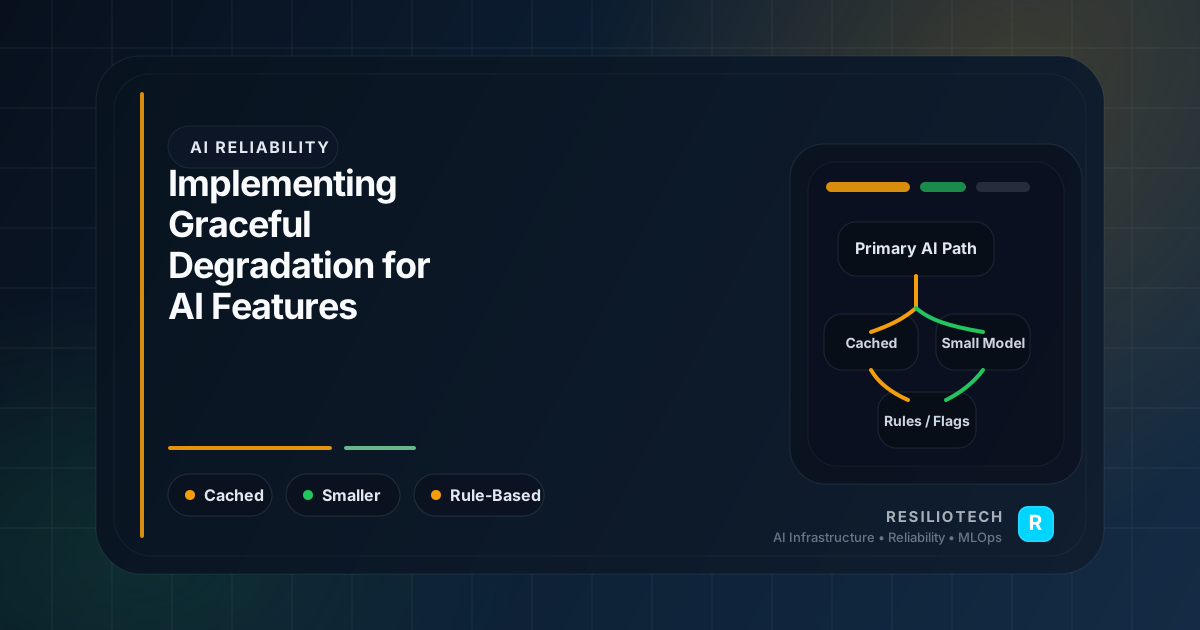
Pattern 6: Add Graceful Degradation for Agents, Not Just Models
Agents fail in more modes than plain LLM features, so their fallback design has to be broader.
Fallback options include:
- reduce from agentic workflow to single-turn answer generation
- disable write tools and allow read-only mode
- cap the plan to fewer steps
- route to cached or retrieval-only results
- require human approval for risky actions
For example, if the ticketing tool is degraded, the system can still:
- draft the support response
- show the human operator the recommended action
- skip the write side effect
That is much better than failing the entire user interaction.
This is an extension of graceful degradation for AI features, but agents need degradation at the workflow level, not only at the model level.
Pattern 7: State and Memory Need Operational Boundaries
Memory is one of the most overloaded terms in agent systems.
In production, split it into at least three categories:
- request context: data only for the current run
- session memory: scoped conversational or task state
- durable business state: facts stored in real systems
The mistake is treating all of these like prompt history.
Rules that help
- prompt context should not be the source of truth for durable state
- long-term memory must have ownership and retention policy
- memory writes should be explicit actions, not incidental side effects
- sensitive memory should follow the same security controls as any other data store
This matters for correctness and compliance. If an agent “remembers” something important, operators need to know where that memory actually lives and how it can be inspected or deleted.
Pattern 8: Observability Must Track the Whole Run, Not Only the Final Answer
This is where most agent systems are weakest.
Teams log the final prompt and final response, but the meaningful operational story lives in the middle:
- plan steps
- tool selection
- retries
- error classification
- latency per stage
- budget usage
- fallback activation
If you only log the final answer, you cannot explain why a run was slow, expensive, or wrong.
What to trace
Each run should emit structured events such as:
run_startedmodel_call_startedmodel_call_completedtool_call_startedtool_call_failedretry_scheduledbudget_exceededfallback_activatedrun_completed
Each event should include:
run_idstep_id- model name
- tool name if relevant
- latency
- token counts
- cost estimate
- result classification
That makes it possible to reconstruct runs later and build real reliability dashboards.
Metrics that actually matter
For ai agents production infrastructure, useful metrics include:
- run success rate
- success rate by terminal state
- average steps per run
- tool error rate by tool
- retry rate by failure class
- budget-exceeded rate
- fallback activation rate
- cost per successful run
- median and P95 total run duration
Those metrics are much more informative than a generic “LLM request success rate.”
Example trace schema
{
  "run_id": "agt_01J9M7R2",
  "step_id": 3,
  "event": "tool_call_failed",
  "tool": "fetch_account",
  "latency_ms": 412,
  "error_type": "timeout",
  "retryable": true,
  "cost_usd": 0.011
}
This kind of event stream lets you build the equivalent of distributed tracing for agent runs.
Pattern 9: Evaluate Agents by Path Quality, Not Only Final Accuracy
Production agent reliability is not just “did the answer look okay?”
You also care about:
- did it use the right tools?
- did it take too many steps?
- did it retry excessively?
- did it trigger a write action safely?
- did it stay inside policy and budget?
That means your eval system needs path-aware checks, not just answer scoring.
Useful evaluation dimensions:
- tool selection precision
- action correctness
- step count distribution
- unnecessary loop rate
- policy-violation rate
- cost-per-task distribution
This should connect to the same release discipline you use elsewhere in production AI, including eval pipelines that catch regressions before users.
Pattern 10: Permission Boundaries Must Be Stronger Than the Prompt
One of the most dangerous mistakes in agent systems is assuming the prompt is the main safety control. It is not.
Prompts help shape behavior, but real production safety comes from infrastructure boundaries:
- what tools are available
- which identities the run can act as
- which resources each tool can access
- which actions require approval
- which write paths are blocked entirely
In practice, agent runs should execute with scoped credentials and policy-limited capabilities, not broad internal access. A support agent should not inherit the same privileges as a human admin just because the human triggered the request.
Useful patterns include:
- per-tool authorization checks
- tenant-scoped credentials
- read-only and write-capable tool separation
- approval gates for irreversible actions
- policy engines that deny unsafe tool combinations
This matters because tool misuse is rarely dramatic in the logs. It often looks like a plausible sequence of individually valid calls that, taken together, exceed what the system should have been allowed to do.
For higher-risk workflows, a human-in-the-loop checkpoint is still the right call. The orchestrator should be able to pause the run, surface the proposed action, and wait for approval rather than forcing every decision into full autonomy.
That is not a failure of the agent design. It is the correct application of control boundaries.
Pattern 11: Runbooks and Incident Response Need Agent-Specific Failure Modes
When agent systems fail, the incident is often not a hard outage.
Common incidents include:
- one tool starts timing out, causing cascading retries
- a routing change doubles cost per run
- a new prompt or planner causes longer loops
- a write tool begins creating duplicate actions
- a model provider degrades and pushes more runs into fallback mode
Those should have explicit runbooks, just like model-serving incidents do.
Useful agent runbook triggers:
- tool error rate over threshold
- median steps per run spikes
- per-run cost anomaly
- fallback rate increases sharply
- budget-exceeded rate jumps
This is where AI incident response runbooks become directly relevant. Agents simply introduce more internal failure modes that need coverage.
Pattern 12: Roll Out Agents Like Workflows, Not Like Prompt Tweaks
Teams often release agent changes too casually. A planner prompt changes, a tool becomes available, or a budget threshold is relaxed, and it gets treated like a small config edit.
Operationally, those are workflow changes. They can alter:
- which tools get called
- how many steps a run takes
- how much each task costs
- whether side effects happen more often
- which fallback path activates
That means rollout safety matters.
A sane release path for agent systems usually includes:
- offline eval on task suites
- shadow runs against real-but-non-mutating traffic
- limited canary exposure
- cost and step-count comparison against baseline
- fast rollback to previous orchestrator or policy version
This is especially important for tool-enabled agents. A new model or planner may not degrade answer quality visibly, but it can still double average step count or trigger more write actions than before. Those are production regressions even if the final text output looks fine.
Treat agent releases like multi-component system changes, not like isolated prompt experiments.
A Practical Reference Pattern
For most teams, a sane production agent stack looks like this:
-
Gateway or API layer Enforces auth, quotas, tenant identity, and request normalization.
-
Agent orchestrator Owns run state, deadlines, budgets, and step sequencing.
-
Model layer Provides planning, synthesis, critique, or classification calls with strict timeouts and model-tier policy.
-
Tool adapter layer Wraps internal and external systems with typed schemas, auth, retries, and idempotency.
-
State and event store Records run state, step history, costs, and audit events.
-
Observability and policy Tracks traces, budgets, fallback activation, and policy violations.
That is the basic production shape. You can implement it with different technologies, but if one of those responsibilities is missing entirely, the system usually becomes fragile fast.
Final Takeaway
Reliable agents are not created by prompts alone. They are created by infrastructure that limits and explains the behavior of a probabilistic control loop.
The most important patterns for agentic ai infrastructure are straightforward:
- explicit orchestration
- typed and guarded tool adapters
- bounded retries
- deadlines and step caps
- per-run cost budgets
- workflow-level graceful degradation
- run-level observability
If you are trying to deploy ai agents reliably, the key mindset shift is this:
- treat the agent like a workflow system with an LLM decision layer, not like a single chat completion with extra features
That is the difference between a compelling demo and a production system that survives real traffic, real costs, and real failures.