Media platforms rarely struggle because they lack AI ideas. They struggle because the infrastructure behind those ideas is asked to do too many different jobs at once.
A modern media or content product may need to support:
- personalized recommendations on every page load
- ranking and retrieval for search or discovery
- automated moderation for text, images, and video metadata
- generative AI for summaries, descriptions, or creator tools
Each of those features has a different traffic pattern, latency tolerance, and cost profile. When teams treat them as one generic “AI service,” they usually create either slow product surfaces or expensive infrastructure.
That is why media platform ai infrastructure should be designed around workload classes, not only around model choice.
This guide focuses on the architecture patterns that matter most when a media company needs to serve personalization to millions of users while also running moderation and generative workloads safely.
The practical challenge is not:
- how do we deploy a model?
It is:
- how do we run recommendation, moderation, and generative systems together without breaking product latency, relevance, or margins?
Start With the Reality: Media AI Is a Multi-Speed System
Media AI is not one pipeline. It is at least three.
1. Interactive personalization
This includes:
- home feed ranking
- next-content recommendations
- search reranking
- notification targeting
These paths are latency-sensitive and directly affect engagement.
2. Safety and moderation
This includes:
- text moderation
- image and video metadata screening
- comment or community safety checks
- spam and abuse scoring
These paths can be synchronous or asynchronous depending on product design, but they usually have strong correctness and auditability requirements.
3. Generative media features
This includes:
- title or description generation
- content summarization
- creator-assist tooling
- localization or caption enhancement
These paths are often more expensive per request and are rarely safe to run with the same assumptions as recommendation serving.
If your platform tries to push all three through one identical runtime and scaling policy, something important gets optimized badly.
Recommendation Systems Need Layered Serving, Not One Giant Model Call
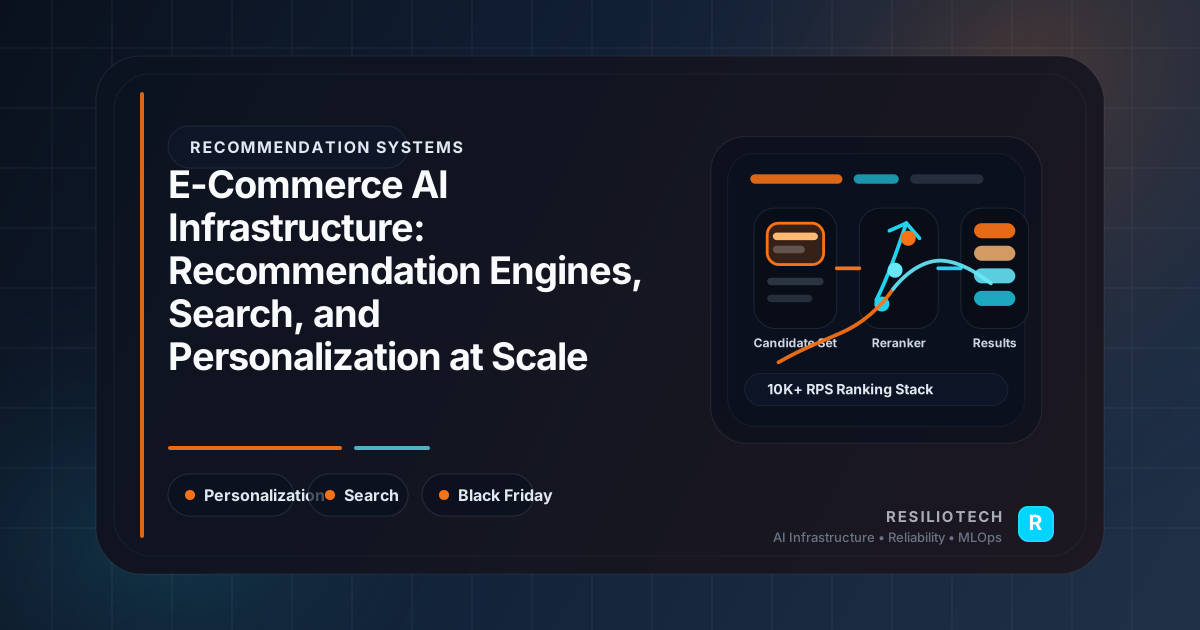
For large content platforms, recommendation is almost never a single model deciding everything.
A more realistic production path looks like:
- candidate generation
- filtering
- ranking or reranking
- business rules and presentation shaping
This matters because the infrastructure required for each step is different.
Candidate generation may rely on:
- embeddings
- approximate nearest neighbor search
- collaborative filtering
- session-based retrieval
Ranking may rely on:
- richer features
- contextual signals
- sequence-aware models
- low-latency inference services
The practical lesson is that content recommendation system deployment should not begin by asking which one big model to serve. It should begin by deciding which stages need:
- precomputation
- online freshness
- hard latency budgets
That is how you avoid turning discovery into a slow model call on every request.
Feature Freshness Decides Whether Personalization Works
Personalization for media platforms becomes irrelevant quickly if the feature pipeline is stale.
Examples:
- a user just watched a full episode, but the system still recommends the same title
- a live event is trending, but the homepage ranking does not reflect it
- a user’s short-term interest changed, but the model is still scoring on yesterday’s state
This is why streaming ai personalization usually requires a mix of:
- batch features for long-term preference
- streaming features for session or recency state
- online retrieval for fresh inventory and availability
Not every signal needs to be real-time, but the few that do matter have to be treated carefully.
A common pattern is:
- batch pipelines build durable user and content features
- stream processors update high-value recency features
- online serving merges both into the ranking path
This is often the difference between a recommendation stack that looks sophisticated in a diagram and one that actually feels adaptive in the product.
Latency Budgets Need to Be Explicit
Media products usually have little tolerance for slow discovery surfaces. A recommendation service that is technically correct but consistently late will still hurt engagement.
That is why the infrastructure team needs an explicit latency budget.
A typical recommendation path might allocate:
- request auth and session fetch: 10-20 ms
- candidate fetch or vector retrieval: 40-80 ms
- ranker inference: 30-80 ms
- post-processing and business rules: 20-40 ms
That leaves very little room for:
- cross-region fetches
- giant feature joins
- heavyweight generative models in the hot path
This is one of the biggest mistakes media teams make when adding AI to content experiences: they insert richer models into user-facing routes without rebalancing the latency budget.
If the route is user-facing, recommendation infrastructure should optimize for predictable tail latency, not only for model cleverness.
Automated Moderation Is a Different Reliability Problem
Moderation infrastructure often gets built by reusing recommendation or classification patterns. That only works partially.
Moderation usually needs more than:
- a score
- a threshold
It also needs:
- explainability or auditability
- quarantining and review paths
- low false-negative tolerance for some content classes
- safe degradation under backlog or incident conditions
For media platforms, moderation also spans multiple content forms:
- text comments
- titles and descriptions
- thumbnails or still images
- user-uploaded metadata
That means the moderation path often becomes multi-model and multi-stage:
- lightweight rules or filters first
- model scoring second
- escalation or human review for ambiguous cases
This is where infrastructure design matters. A moderation job should not fail silently just because a classifier timed out or one downstream review queue backed up.
The safer pattern is:
- synchronous blocking only where product risk requires it
- asynchronous enrichment and review for lower-risk classes
- dead letter or quarantine paths for failed moderation events
That gives the organization a real operating model instead of pretending every moderation decision can be resolved in one synchronous path.
Generative AI Should Usually Be Isolated From Core Recommendation Serving
Media platforms increasingly want generative AI for:
- summaries
- personalized descriptions
- campaign copy
- creator support tools
These are valuable features, but they should usually not share the same serving assumptions as recommendation ranking.
Generative routes tend to have:
- higher per-request cost
- more variable latency
- more complex fallbacks
- stronger logging and policy needs
That is why a mature media platform ai infrastructure often separates:
- low-latency ranking services
- moderation pipelines
- generative AI backends
This does not mean three entirely separate platforms. It means the runtime, scaling, and control policies should reflect real workload differences.
For example:
- recommendation ranking may run on tightly sized, highly predictable inference pools
- moderation may run on mixed sync and async workers
- generative tools may use gateway-based routing across self-hosted and external models
That separation is often what prevents a creative AI feature from degrading the discovery experience for the whole platform.
Multi-Tenant and Multi-Surface Cost Control Matters
Many media companies operate more than one product surface:
- consumer app
- web experience
- internal editorial tools
- creator tools
- moderation back office
If all AI traffic lands on a shared serving pool with weak attribution, cost visibility disappears quickly.
That is why content recommendation system deployment at scale also needs:
- traffic tagging by feature and surface
- budget visibility by model route
- workload separation between interactive and background jobs
- rate and quota controls for internal tools
This becomes even more important once generative AI enters the stack. A high-volume recommendation service and a prompt-heavy internal summary tool should not compete invisibly for the same cost budget.
Cost control is not only a finance concern here. It also protects product performance by preventing one workload class from consuming the cluster in ways nobody notices until latency rises.
Global Delivery Changes the Recommendation Stack
Many media products serve audiences across regions, time zones, and content catalogs. That changes the infrastructure problem in ways that simpler recommendation systems do not always face.
For example:
- content availability may differ by market
- traffic spikes may follow local events and local prime time
- ranking services may need region-aware business logic
- the wrong cross-region dependency can destroy the latency budget
This is why large media systems usually keep the hot discovery path close to the user:
- regional retrieval services where audience size justifies them
- regional caches for high-demand recommendation candidates
- globally replicated model artifacts where possible, but market-specific control logic where needed
If every request for a homepage or playback continuation path has to cross regions to fetch features or rank candidates, the recommendation system can become the bottleneck even when the model itself is fast enough.
Media platforms also face event-driven surges that are more abrupt than ordinary SaaS traffic:
- breaking news
- live sports
- concert streams
- major creator uploads
Those moments change the content graph and the traffic pattern at the same time. The infrastructure needs to handle both. That often means:
- pre-warming popular ranking paths
- aggressively isolating recommendation traffic from background AI jobs
- allowing freshness-sensitive ranking features to update faster than the rest of the batch pipeline
This is one of the biggest reasons streaming ai personalization deserves its own operating model instead of being treated like just another inference service.
Reliability Depends on Clear Fallbacks
Media AI systems degrade in different ways:
- recommendation ranker slowdowns
- moderation queue backlog
- embedding service incidents
- external LLM provider errors
A robust platform decides ahead of time what each product surface does under degradation.
Examples:
- if the reranker times out, fall back to a cheaper or cached ranking path
- if moderation enrichment is delayed, quarantine new items and continue review asynchronously
- if the summary model is unavailable, suppress the generative feature rather than stalling page render
This is especially important in content products because not every AI route deserves equal availability treatment.
Recommendation on the homepage may need aggressive fallback.
Creator-side copy generation may tolerate temporary disablement.
Moderation review tooling may need queue durability more than sub-second response.
That is what good infrastructure policy looks like: the fallback reflects product impact, not only technical preference.
Experimentation Infrastructure Has to Be Safe
Media companies do not only operate AI systems. They constantly experiment on them.
Typical changes include:
- new rankers
- new retrieval signals
- different moderation thresholds
- new generative prompts or model routes
That experimentation is part of the product strategy, but it also makes the infrastructure riskier if rollout controls are weak.
For recommendation systems, safe experimentation usually means:
- shadow scoring before full ranking replacement
- traffic-sliced A/B rollout
- observability split by cohort
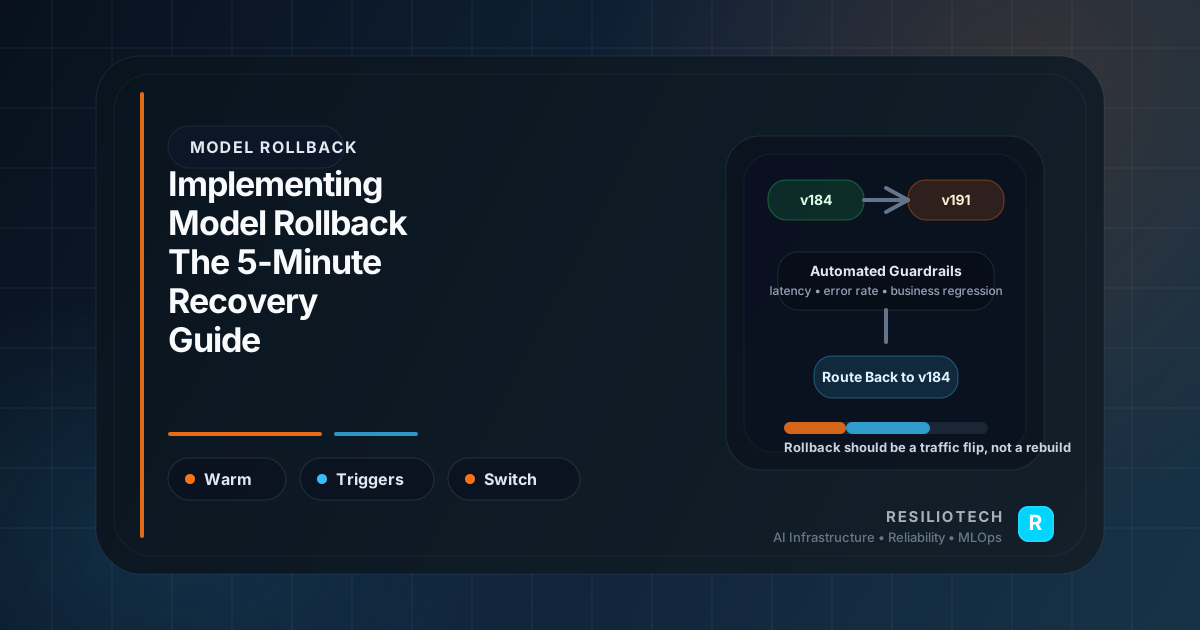
- fast rollback when latency or engagement moves the wrong way
Without that, a recommendation model can look healthy in offline evaluation and still damage the live product because:
- the serving path is too slow
- feature freshness differs in production
- only one user segment is negatively affected
Moderation and generative systems need similar discipline.
A moderation threshold change should be auditable. A new summary model should be easy to disable if output quality drops. Creator-side generation should not roll out without visibility into both cost and latency by route.
This is why content recommendation system deployment and adjacent media AI features should be treated as controlled release systems, not only as model launches. The business impact of a bad rollout is often much larger than the infrastructure symptom that first reveals it.
Observability Must Be Product-Aware
Aggregate cluster dashboards are not enough for media AI.
You need visibility by:
- feature
- surface
- model route
- content type
- region or market where relevant
For recommendation systems, monitor:
- latency by stage
- feature freshness
- ranking throughput
- degraded or fallback response rate
For moderation, monitor:
- queue depth
- classification lag
- DLQ or quarantine volume
- escalation and review backlog
For generative routes, monitor:
- cost per request
- latency distribution
- fallback frequency
- provider or model split
This is how streaming ai personalization becomes operable in production. Without workload-aware observability, the platform team only sees GPU and API metrics while product quality erodes invisibly.
Rollout Strategy: Do Not Launch Everything as “AI”
The safest path for media companies is incremental.
A practical rollout usually looks like:
- ship one high-value recommendation or moderation improvement
- define clear latency and quality expectations
- instrument the route by feature and surface
- add fallback paths before traffic is large
- only then expand into more expensive generative experiences
Represented simply:
One High-Value AI Feature
   |
   v
Latency + Quality Budget
   |
   v
Observability + Fallbacks
   |
   v
Scale by Workload Class
This sequence matters because media AI usually fails from too much concurrency of ambition, not from lack of model options.
If recommendation, moderation, and generative tooling all launch with unclear serving boundaries, the infrastructure team ends up debugging three different problem types at once.
A Practical Reference Pattern
For many media platforms, a strong starting architecture looks like:
- online feature and retrieval services for recommendation
- a low-latency ranker path with strict tail-latency budgets
- asynchronous moderation workers with quarantine support
- a gateway-routed generative layer for creator or editorial workflows
- separate observability and cost views by workload class
This is not the only valid design, but it is a reliable one because it respects the fact that media AI is multi-speed and multi-risk.
That is the core principle behind media platform ai infrastructure: one company may run several AI workloads, but they should not all be treated as the same operational system.
Final Takeaway
Content recommendation system deployment at media scale is not only about serving recommendations faster. It is about running three adjacent AI systems well:
- personalization
- moderation
- generative assistance
To make streaming ai personalization and related features reliable, media companies need:
- layered recommendation serving
- fresh features where they matter
- explicit latency budgets
- separate operating assumptions for moderation and generative workloads
- strong observability, cost attribution, and fallback policy
That is how media platform ai infrastructure becomes a product advantage instead of an operational burden. The models matter, but the real differentiator is whether the platform can serve them reliably under the traffic shape, safety requirements, and content velocity that media companies actually live with.