E-commerce AI systems do not fail only when the site goes down.
They also fail when:
- recommendations arrive too late to render above the fold
- search results stop feeling relevant during a traffic spike
- personalization models collapse into generic fallback rankings
- cold-start items never get enough exposure to learn anything useful
- a model experiment shifts conversion without anyone being sure why
That is what makes e-commerce AI infrastructure harder than a normal model-serving setup.
The models matter, but the business outcome depends on the full serving path:
- event collection
- feature freshness
- low-latency retrieval
- ranking and reranking
- caching
- fallback behavior
- experiment assignment
When traffic is quiet, many architectures look fine. The real test arrives during promotions, marketplace events, and Black Friday windows, when recommendation and search traffic can jump by an order of magnitude while latency budgets get tighter, not looser.
This guide covers the infrastructure patterns we recommend for:
- recommendation engine deployment
- e-commerce search and reranking
- ai personalization infrastructure for high-volume storefronts
- production experiments and cold-start controls
The core question is simple: how do you keep personalized experiences fast and measurable when demand spikes above 10,000 requests per second?
Why E-Commerce AI Infrastructure Is a Special Case
Most production ML systems optimize a few outputs and call it a day.
E-commerce systems have three properties that make infrastructure design much harder.
1. The traffic is extremely bursty
Retail traffic is not smooth.
It moves with:
- campaign launches
- flash sales
- Black Friday and Cyber Monday promotions
- influencer or paid acquisition spikes
- email and push notifications landing at once
That means your recommendation tier cannot be sized only for average traffic. The architecture must survive concentrated demand while preserving the latency users expect from browsing and checkout flows.
2. Relevance and latency are tightly linked
A homepage rail that appears after the user scrolls past it may as well not exist.
A search reranker that misses the render budget turns “smart search” into ordinary lexical search. A personalized upsell panel that times out gets replaced with generic products and quietly loses value.
In practice, the business target is not “run a model.” It is:
- return useful results
- within a strict render budget
- at very high concurrency
3. The system is part recommendation engine, part distributed systems problem
A typical e-commerce AI stack is not one model. It is a chain of decisions:
- candidate retrieval
- filtering by inventory and policy
- ranking
- business-rule blending
- diversification
- caching and serving
That chain is what determines conversion, click-through, revenue per session, and operational cost. If any layer becomes stale or overloaded, the model can remain technically healthy while the experience degrades.
Start by Separating Retrieval, Ranking, and Rendering Budgets
One of the most common mistakes in e-commerce recommendation engine deployment is treating the whole recommendation path as one black box.
Break it into stages.
For example, a homepage recommendation request might have:
| Component | Target |
|---|---|
| request routing and auth | 5 ms |
| candidate retrieval | 12 ms |
| feature lookup | 10 ms |
| ranking or reranking | 15 ms |
| filtering and merchandising rules | 8 ms |
| response serialization | 5 ms |
| safety margin | 5 ms |
That yields a 60 millisecond service budget for one personalized rail.
You should do the same exercise for:
- homepage recommendations
- product detail page related items
- cart upsells
- search reranking
- email or notification personalization APIs
Those workflows should not share identical latency assumptions. Search reranking often has different limits from a best-effort recommendation rail, and cart-related recommendations often deserve stricter budgets because they sit closer to revenue.
The Architecture Pattern That Holds Up at 10K+ RPS
For most high-scale retail systems, we recommend a multi-stage serving path instead of a giant monolithic model call.
The usual pattern looks like this:
- route the request by surface and experiment bucket
- fetch candidate items from a fast retrieval layer
- enrich with only the features needed online
- score or rerank a bounded candidate set
- apply inventory, policy, and merchandising constraints
- return results with a deterministic fallback if needed
- log impressions, placements, and experiment context asynchronously
The critical principle is that retrieval and ranking should be bounded.
Do not send the full catalog through an online model at peak traffic. The system needs a fast candidate-generation tier first:
- approximate nearest-neighbor retrieval
- co-visitation or collaborative filtering candidate tables
- popular-in-segment caches
- category-specific retrieval indices
Then apply the more expensive ranking model to a much smaller set.
That is what makes 10K+ RPS feasible without requiring absurdly large serving fleets.
Black Friday Changes the Problem
During Black Friday, normal serving assumptions break.
Why?
- item popularity changes faster
- inventory changes faster
- promotions override normal relevance
- session volume spikes sharply
- new users arrive in higher proportions
This means two things happen at once:
- traffic rises
- the underlying signal distribution changes
A system that performs well during steady-state traffic may fail during Black Friday not because throughput is too low, but because the platform is overfit to old ranking assumptions.
To prepare for that window, infrastructure should support:
- separate capacity planning for peak retail events
- aggressive cache warming for major surfaces
- explicit fallback recommendation sets per category or campaign
- fast inventory-aware filtering
- experiment guardrails that can be disabled quickly if performance moves
A useful rule: Black Friday personalization should degrade explicitly, not accidentally.
If the ranking stack saturates, you want controlled fallback modes such as:
- popular products by category
- campaign-curated items
- recent best-sellers by segment
- rules-based related products
What you do not want is silent timeout behavior where half the requests get generic results without visibility.
Recommendation Engine Deployment Needs More Than a Model Server
Many teams approach recommendation engine deployment as if they only need to host the ranking model.
That leaves out the harder parts.
A production recommendation path usually includes:
- feature generation
- candidate retrieval
- ranking
- diversity or fairness constraints
- business-rule overlays
- experiment assignment
- logging and attribution
Any one of these can become the bottleneck.
For example:
- the ranking service may be fast, but feature joins are stale
- candidate retrieval may be fast, but inventory filtering removes too many items
- the model may be correct, but experiment assignment is inconsistent across requests
- the serving layer may be healthy, but impression logs are delayed, weakening feedback loops
This is why strong e-commerce AI infrastructure treats the recommendation path as a product system, not a notebook artifact with an API.
Caching Has To Be Deliberate
Caching is essential at high scale, but it is easy to do badly.
The wrong cache strategy can:
- serve stale personalized results
- amplify popularity bias
- hide cold-start items forever
- create incoherent experiences across surfaces
A good cache hierarchy often includes:
- global popular-item caches
- category or query-level caches
- segment-level recommendation caches
- short-lived per-session caches for repeated surfaces
Avoid pretending every request needs unique real-time scoring. Many retail surfaces can use hybrid strategies:
- cached candidates
- fresh inventory filtering
- light reranking on top
That keeps latency predictable while preserving enough adaptability for personalization.
The key is to be explicit about cache freshness and invalidation. If inventory, price, or campaign eligibility changes faster than the cache refresh, the recommendation layer starts producing operationally wrong outputs even if ranking quality is fine.
Cold Start Is Not a Side Problem
Cold start is one of the main reasons e-commerce personalization systems underperform in practice.
You have cold-start problems for:
- new users
- anonymous sessions
- new items
- new categories
- new campaigns
If the infrastructure does not handle these intentionally, the model becomes biased toward already popular products and already well-profiled users.
Cold start for users
For new or anonymous sessions, you usually need a layered fallback:
- popular-by-surface results
- category popularity
- contextual signals like geo, device, referral source, or campaign
- session-based features that accumulate quickly
The important part is that the system should promote from generic to personalized behavior gradually as signal becomes available. Do not wait for a fully populated user profile before personalizing anything.
Cold start for items
This is often more damaging.
A new product with no interactions may never get shown enough to learn, especially when the platform over-optimizes for short-term click-through.
A good ai personalization infrastructure includes explicit exploration capacity for new items:
- controlled exposure buckets
- similarity-based candidate generation from metadata or embeddings
- business-rule boosts for launch windows
- exploration traffic isolated in experiments
Cold-start handling is not just a model trick. It is a serving policy decision.
If the serving layer never surfaces new items, no downstream model can fix that.
Feature Freshness Matters as Much as Model Quality
Recommendation and search systems are highly sensitive to stale signals.
If browsing, cart, inventory, or popularity features lag during a peak event, ranking quality degrades quietly.
Common failure modes:
- inventory status is stale and unavailable products are recommended
- clickstream ingestion lags, so trending intent never reaches the ranker
- pricing and promotion features update late
- user-segment assignments are computed on outdated windows
This is why ecommerce ai infrastructure should track:
- feature age by group
- freshness of clickstream and cart events
- inventory and availability lag
- fallback feature rate
- share of requests served with degraded data
A model can return scores in 10 milliseconds and still hurt the business if the features are two hours old during a major campaign.
Search and Personalization Should Share Some Infrastructure, Not All of It
Search and recommendations usually overlap, but they are not identical workloads.
Search needs:
- query retrieval
- filtering by text and structured constraints
- optional semantic retrieval
- reranking that respects the query intent
Recommendations need:
- user or session context
- affinity and co-occurrence signals
- exploration and diversity logic
- placement-specific ranking
You can share some components:
- feature services
- experiment platform
- observability
- inventory and catalog APIs
- model registry and rollout tooling
But do not force both problems into the same serving path if the latency and failure modes differ.
Search degradation often needs query-safe fallback logic. Recommendation degradation often needs popularity- or rule-based fallback logic. That distinction should be visible in your architecture.
A/B Testing in Production Needs Infrastructure Discipline
Teams often say they are A/B testing models when they are really just splitting traffic loosely.
Proper production experiments for ranking and personalization need consistent assignment and trustworthy attribution.
At minimum, your experiment stack should preserve:
- stable user or session bucketing
- experiment metadata attached to each served response
- impression logging with model and variant context
- click, add-to-cart, and purchase attribution
- fast rollback when latency or quality moves the wrong way
For ranking systems, you also need to think carefully about interference.
Why? Because exposure changes future training data.
If one model gets more exploratory placement, its click and conversion metrics are not directly comparable without understanding how traffic was shaped.
A production-grade experiment setup should log:
- experiment ID
- variant
- candidate pool version
- ranker version
- fallback usage
- placement position
- request latency
Without those fields, post-experiment analysis becomes guesswork.
Safe Rollouts Beat Big-Bang Promotions
A new ranker should not go from offline win to full Black Friday traffic in one jump.
A safer rollout sequence is:
- offline validation on recent traffic windows
- replay or shadow inference against production requests
- limited-surface canary
- experiment ramp with guardrails
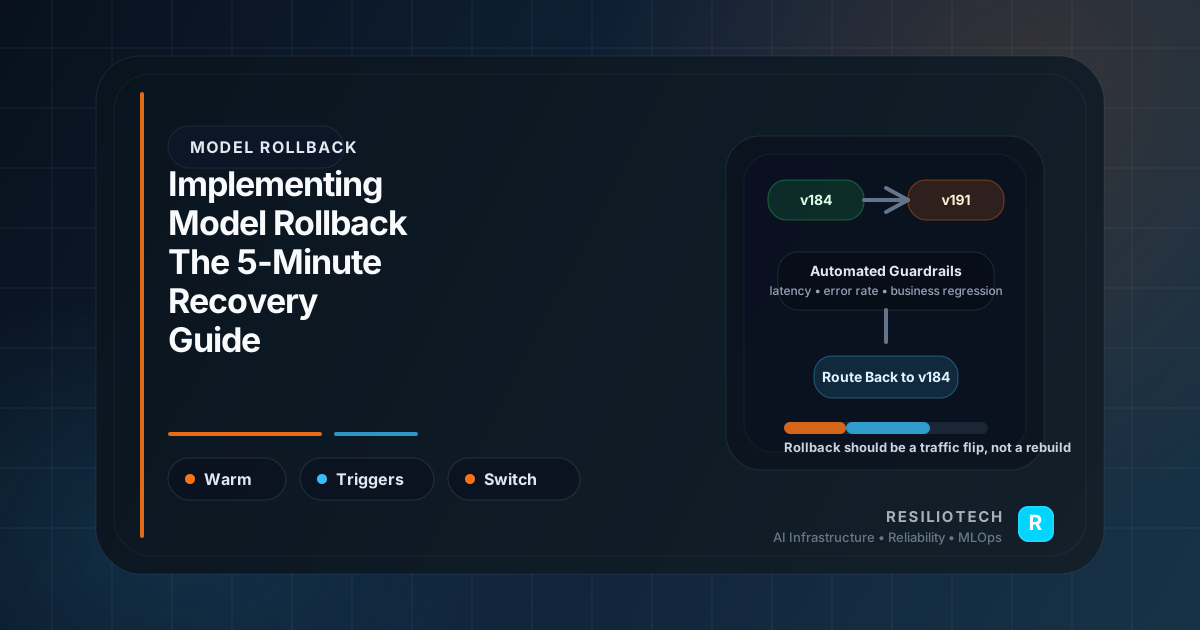
- production promotion with rollback kept warm
Guardrails should cover more than conversion.
Also watch:
- latency
- timeout rate
- item coverage
- new-item exposure
- inventory mismatch rate
- add-to-cart or downstream revenue movement
This is especially important because some ranking changes improve clicks while hurting margin, stock efficiency, or downstream conversion quality.
What To Monitor During Peak Retail Events
Your dashboard should connect system health to merchandising outcomes.
Track at minimum:
- p50, p95, and p99 latency by surface
- candidate retrieval latency
- ranking latency
- cache hit rate by layer
- feature freshness
- inventory mismatch rate
- fallback or degraded-mode rate
- experiment split health
- click-through, add-to-cart, and revenue-per-session movement
For Black Friday, add peak-event-specific views:
- request volume by minute
- queue depth or concurrency saturation
- warm-capacity headroom
- popular-item and category cache age
- percentage of traffic on fallback rails
The right question is not “is the service up?” It is “is the personalization system still influencing the storefront the way we expect under pressure?”
Common Mistakes
We see these repeatedly in e-commerce AI systems:
- trying to rank too much of the catalog online instead of using bounded candidate retrieval
- assuming average traffic is enough for capacity planning
- treating cold start as a data science backlog item instead of a serving policy problem
- over-caching personalized results without clear freshness rules
- running A/B tests without reliable impression and variant logging
- ignoring inventory and promotion state in the serving path
Most of these are infrastructure and operating-model failures, not model failures.
A Practical Starting Architecture
If your team is building or replacing an e-commerce personalization stack, phase one should be intentionally narrow:
- one candidate retrieval path per major surface
- one online feature service with freshness monitoring
- one ranking service template
- one experiment and attribution standard
- one explicit cold-start policy for users and items
- one deterministic fallback path for peak traffic
That is enough to support serious production traffic without overbuilding a giant platform before the core operating model is stable.
Final Takeaway
E-commerce AI infrastructure is a systems discipline disguised as a relevance problem.
The best recommendation and personalization platforms win because they keep retrieval bounded, features fresh, experiments trustworthy, and fallback behavior explicit when traffic surges. That is what allows recommendation engine deployment to hold up at Black Friday scale instead of collapsing into generic best-sellers the moment demand spikes.
If you are building ecommerce ai infrastructure for search, ranking, and personalization, start with three questions:
- what is the true latency budget per surface?
- how do we preserve quality and coverage during cold start and peak traffic?
- can we measure model changes cleanly in production without corrupting attribution?
Those answers will shape a much stronger system than another offline leaderboard ever will.