Mixture-of-Experts (MoE) models like Mixtral 8x7B or DBRX look efficient on paper because only a subset of experts activates for each token. However, mixture of experts production deployment is more complex than serving dense models. The full model still creates a massive memory footprint, and GPU memory management becomes a critical bottleneck.
Memory and Topology: The Real MoE Footprint
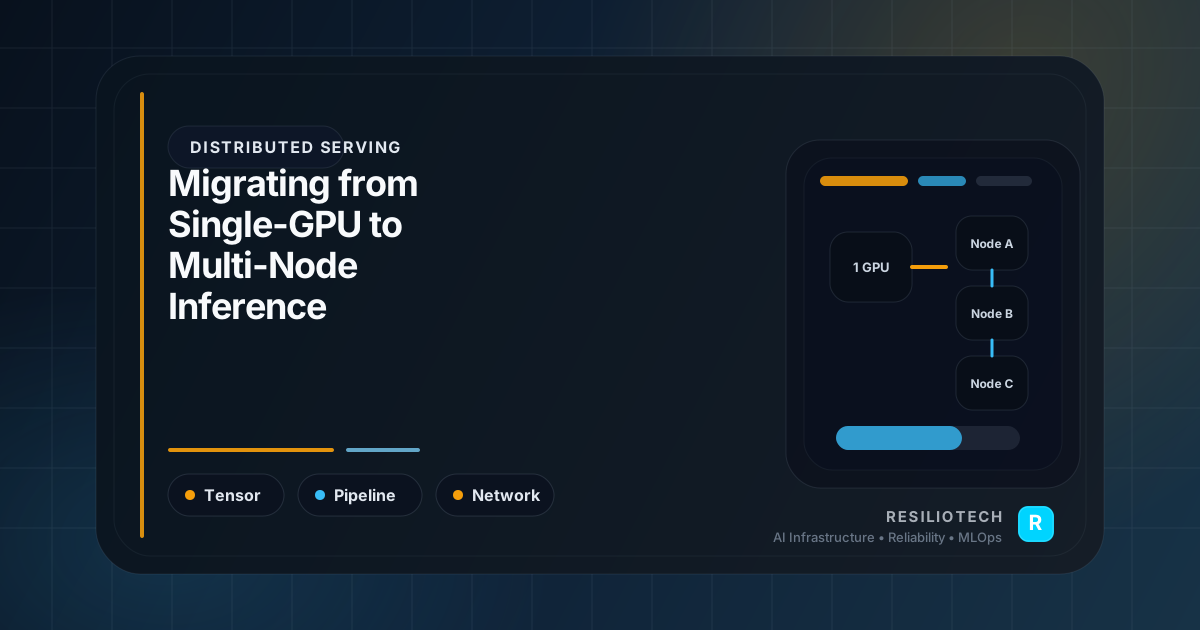
Even if you only activate 2 out of 8 experts per token, you typically need all experts resident in VRAM to avoid massive latency penalties from swapping. This often forces a multi-node inference strategy for larger MoE variants.
Technical Depth: vLLM with Tensor Parallelism for MoE
When deploying moe model kubernetes, you must use a runtime that supports efficient tensor parallelism. vLLM handles this well by sharding the model across multiple GPUs on a single node or across multiple nodes using NCCL.
apiVersion: apps/v1
kind: Deployment
metadata:
  name: mixtral-8x7b-deployment
spec:
  replicas: 1
  template:
    spec:
      containers:
      - name: vllm-server
        image: vllm/vllm-openai:latest
        args:
        - "--model"
        - "mistralai/Mixtral-8x7B-Instruct-v0.1"
        - "--tensor-parallel-size"
        - "8" # shard across 8 GPUs (e.g., an A100x8 node)
        - "--gpu-memory-utilization"
        - "0.95"
        resources:
          limits:
            nvidia.com/gpu: 8
For more on vLLM configuration, check out our guide on serving open-source LLMs with vLLM on Kubernetes.
Expert Routing and Uneven Activation
The biggest production issue with MoE is that traffic does not hit experts evenly. Skewed workloads can lead to "hot experts," where a subset of the model is saturated while others are idle. This requires careful capacity planning to ensure p99 latency doesn't explode during bursts.
Monitoring GPU Memory Saturation
In MoE systems, fragmentation is common. Use this Prometheus alert to detect when your KV cache is becoming dangerously full, which often precedes an OOM or a massive latency spike:
# alert if KV cache usage exceeds 90% for more than 5 minutes
resource "kubernetes_manifest" "kv_cache_alert" {
  manifest = {
    apiVersion = "monitoring.coreos.com/v1"
    kind       = "PrometheusRule"
    metadata = {
      name = "vllm-kv-cache-usage"
    }
    spec = {
      groups = [{
        name = "vllm.rules"
        rules = [{
          alert = "HighKVCacheUsage"
          expr  = "vllm:gpu_cache_usage_perc > 90"
          for   = "5m"
          labels = { severity = "warning" }
          annotations = { summary = "High KV cache usage on {{ $labels.pod }}" }
        }]
      }]
    }
  }
}
Final Takeaway: Optimizing MoE at Scale with Resilio Tech
Mixture of experts production deployment succeeds when teams move beyond parameter counts and focus on system behavior. The real challenges lie in managing memory residency, minimizing routing overhead, and handling expert skew across a distributed GPU cluster.
At Resilio Tech, we specialize in deploying frontier MoE models in production environments. We help you architect high-performance Kubernetes clusters with NVLink-optimized topologies, implement tensor parallelism using vLLM and DeepSpeed, and build custom observability stacks to track per-expert activation. Our goal is to ensure your MoE workloads are both cost-effective and rock-solid in production.
Thinking about moving to an MoE architecture? Contact Resilio Tech for a deep-dive infrastructure audit and deployment strategy session.